Beyond the Desktop: Porting AyuCI to React Native
- Samarth Meditech Engineering
- January 5, 2026
- 02 Mins read
- Mobile , React-native , Expo
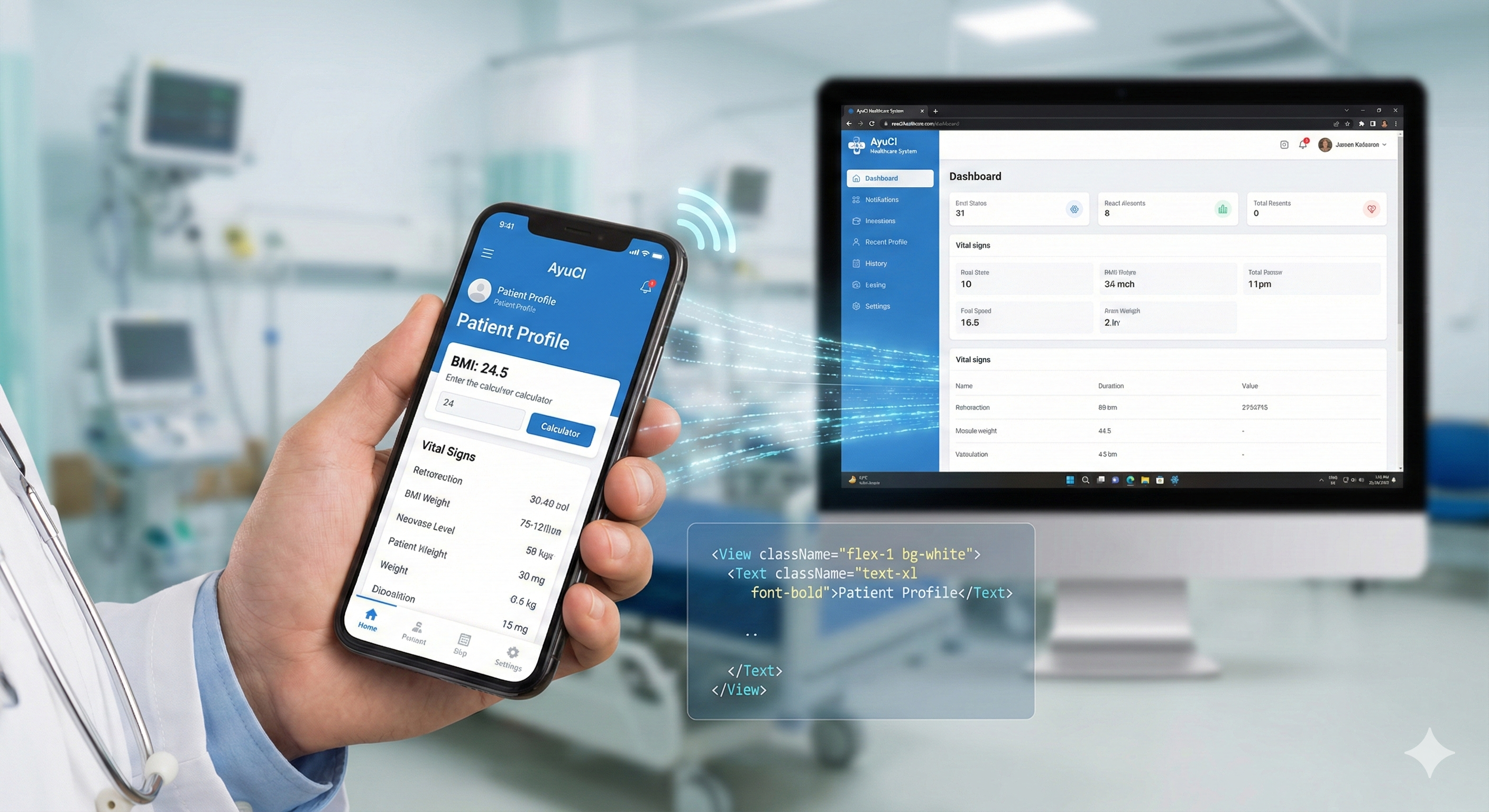
For years, hospital management systems were tethered to heavy workstations. But in a modern ward, minutes matter. To truly empower healthcare providers, we realized that AyuCI couldn’t just be a web dashboard—it needed to be a high-performance mobile experience.
Choosing the right mobile strategy was critical. We opted for React Native and Expo to ensure we could maintain a single logic layer while delivering a truly native feel on both Android and iOS.
The Challenge of “Mobile-First” Healthcare
Designing for mobile in a hospital isn’t just about shrinking a website. It requires rethinking the “Point of Care” interaction. A doctor needs to calculate a patient’s BMI, check a lab report, or verify a drug dosage while standing at the bedside.
To handle styling, we implemented NativeWind, allowing us to use Tailwind CSS patterns across our mobile components. This ensured visual consistency between our Next.js web dashboard and our mobile APK, reducing the cognitive load for doctors switching between devices.
Engineering the “Instant-On” Experience
One of our biggest hurdles was managing the build process. We moved from Expo Go to Development Builds early in the process. This shift allowed us to integrate custom native modules—essential for the specialized hardware sometimes found in medical environments, such as Bluetooth-enabled diagnostic tools.
Mobility in healthcare isn’t a luxury; it’s a safety feature. By putting the EMR in the doctor’s pocket, we eliminate the ‘transcription gap’ between the patient bed and the nursing station.
Product Lead
Bridging Web and Native Workflows
A significant technical win was our approach to shared state. By utilizing a unified API layer built with FastAPI and Node.js, our mobile app consumes the same high-integrity data as our web platform.
We also implemented specialized mobile components, such as our custom BMI Calculator, which utilizes high-precision math libraries to ensure clinical accuracy. These small but vital tools are what turn a mobile app into a medical instrument.
Scaling for the Future
As we look toward the next version of the AyuCI mobile app, we are exploring offline-first synchronization. This will allow our app to store data locally in a secure, encrypted SQLite database when Wi-Fi in the ward is spotty, automatically syncing back to our AWS EC2 production servers once a connection is re-established.
Samarth Meditech is committed to ensuring that healthcare technology is as mobile and agile as the professionals who use it.